> ## Documentation Index
> Fetch the complete documentation index at: https://archie.com/docs/llms.txt
> Use this file to discover all available pages before exploring further.
# Custom APIs
> Register HTTP routes that reverse-proxy to internal services with CORS, rate limiting, request transformation, circuit breakers, and caching.
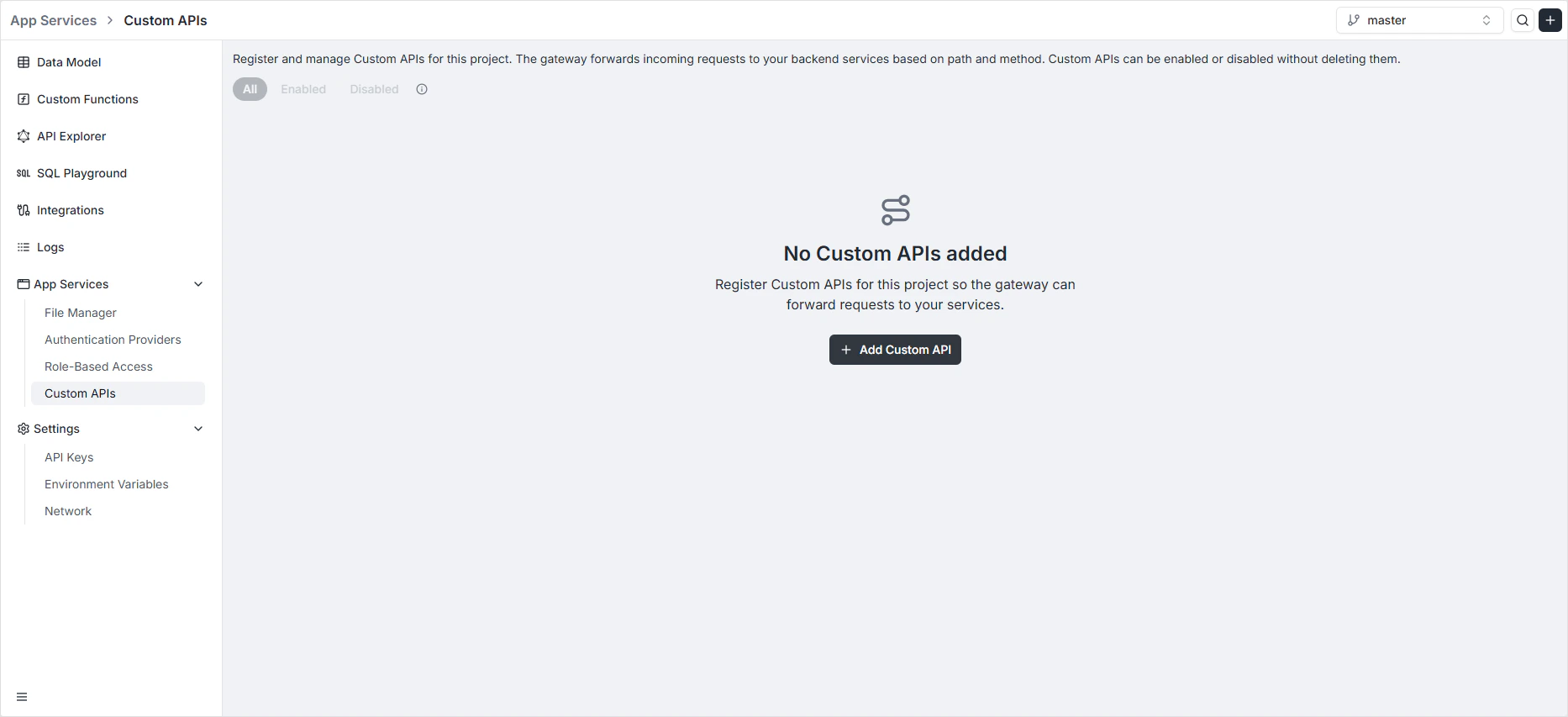
Custom APIs are HTTP routes you register on Archie's gateway that reverse-proxy to internal services. Each route maps a public-facing URL path to a target URL and brings the target under the same auth, CORS, rate-limiting, and resilience policies as the rest of your backend.
Use a Custom API when:
* You have an existing internal service you want to expose under your project's domain.
* You want CORS, rate limiting, or a circuit breaker in front of a third-party endpoint.
* You need request/response transformation that doesn't belong in your service code.
For CRUD against the [Data Model](/features/backend/data-model/overview), you don't need a Custom API — the auto-generated [GraphQL](/features/backend/graphql-api-explorer/overview) and [REST](/features/backend/rest-api-explorer/overview) APIs already cover that.
To open it, navigate to **App Services → Custom APIs** in the Backend Console.
 ## Per-environment scoping
Routes are scoped per environment. Each [environment](/features/backend/environments/overview) has its own routes — production routes can point at production services while `dev` routes point at staging instances of the same service.
When branching an environment with the **Gateway routes** copy option, every route is duplicated into the new environment. Each copy receives a new ID and can be edited independently.
## Registering a route
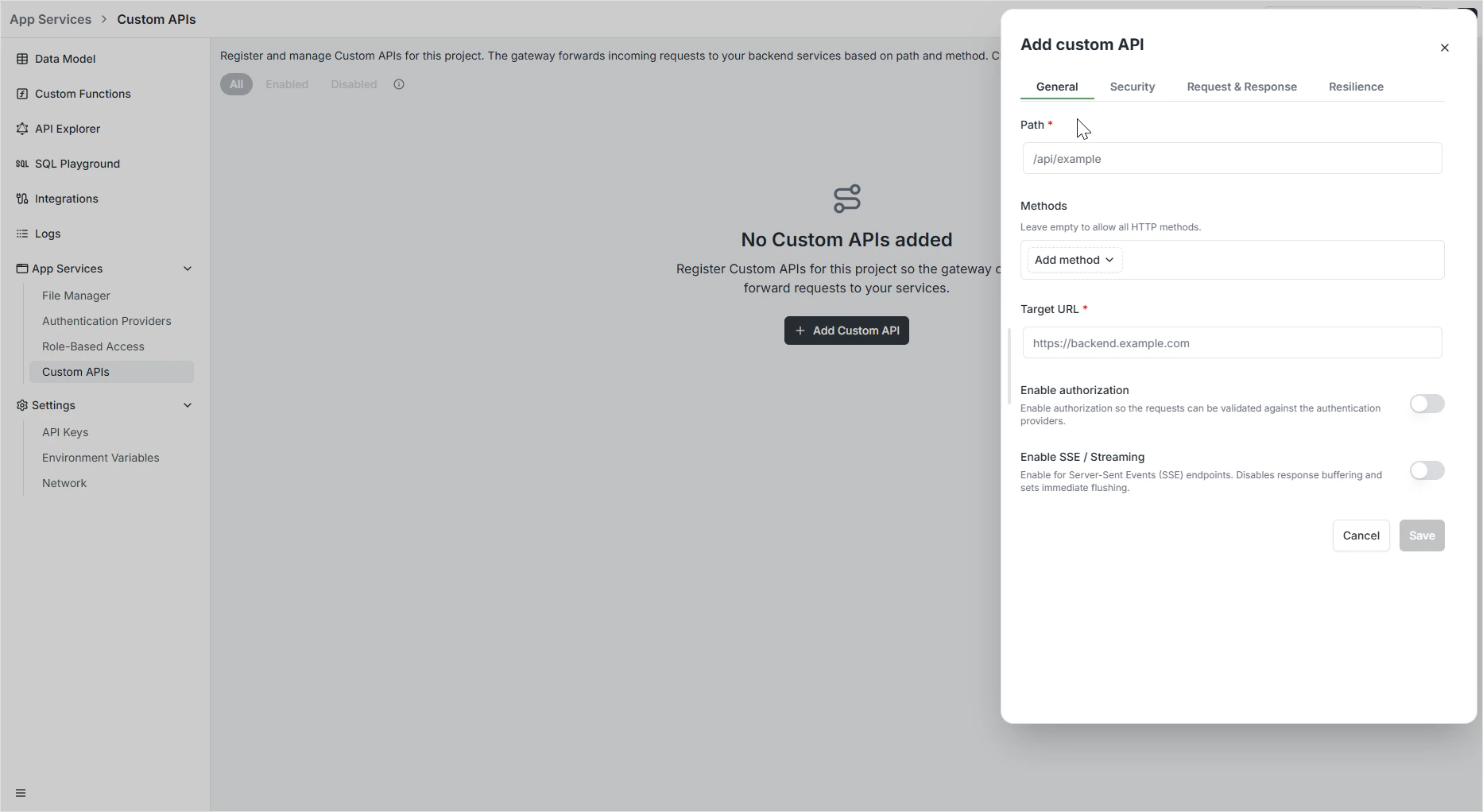
The configuration is split across four tabs: **General**, **Security**, **Request & Response**, and **Resilience**.
### General — routing logic
The **General** tab defines what the route catches and where it goes.
| Field | Purpose |
| -------------- | -------------------------------------------------------------------------- |
| **Path** | Public-facing URI path clients call (e.g., `/api/v1/users`). |
| **Target URL** | Internal destination URL where the gateway forwards the request. |
| **Methods** | HTTP verbs the route responds to: `GET`, `POST`, `PUT`, `PATCH`, `DELETE`. |
| **Enabled** | Toggle to activate or deactivate the route without deleting it. |
## Per-environment scoping
Routes are scoped per environment. Each [environment](/features/backend/environments/overview) has its own routes — production routes can point at production services while `dev` routes point at staging instances of the same service.
When branching an environment with the **Gateway routes** copy option, every route is duplicated into the new environment. Each copy receives a new ID and can be edited independently.
## Registering a route
The configuration is split across four tabs: **General**, **Security**, **Request & Response**, and **Resilience**.
### General — routing logic
The **General** tab defines what the route catches and where it goes.
| Field | Purpose |
| -------------- | -------------------------------------------------------------------------- |
| **Path** | Public-facing URI path clients call (e.g., `/api/v1/users`). |
| **Target URL** | Internal destination URL where the gateway forwards the request. |
| **Methods** | HTTP verbs the route responds to: `GET`, `POST`, `PUT`, `PATCH`, `DELETE`. |
| **Enabled** | Toggle to activate or deactivate the route without deleting it. |
 ### Security — CORS and rate limiting
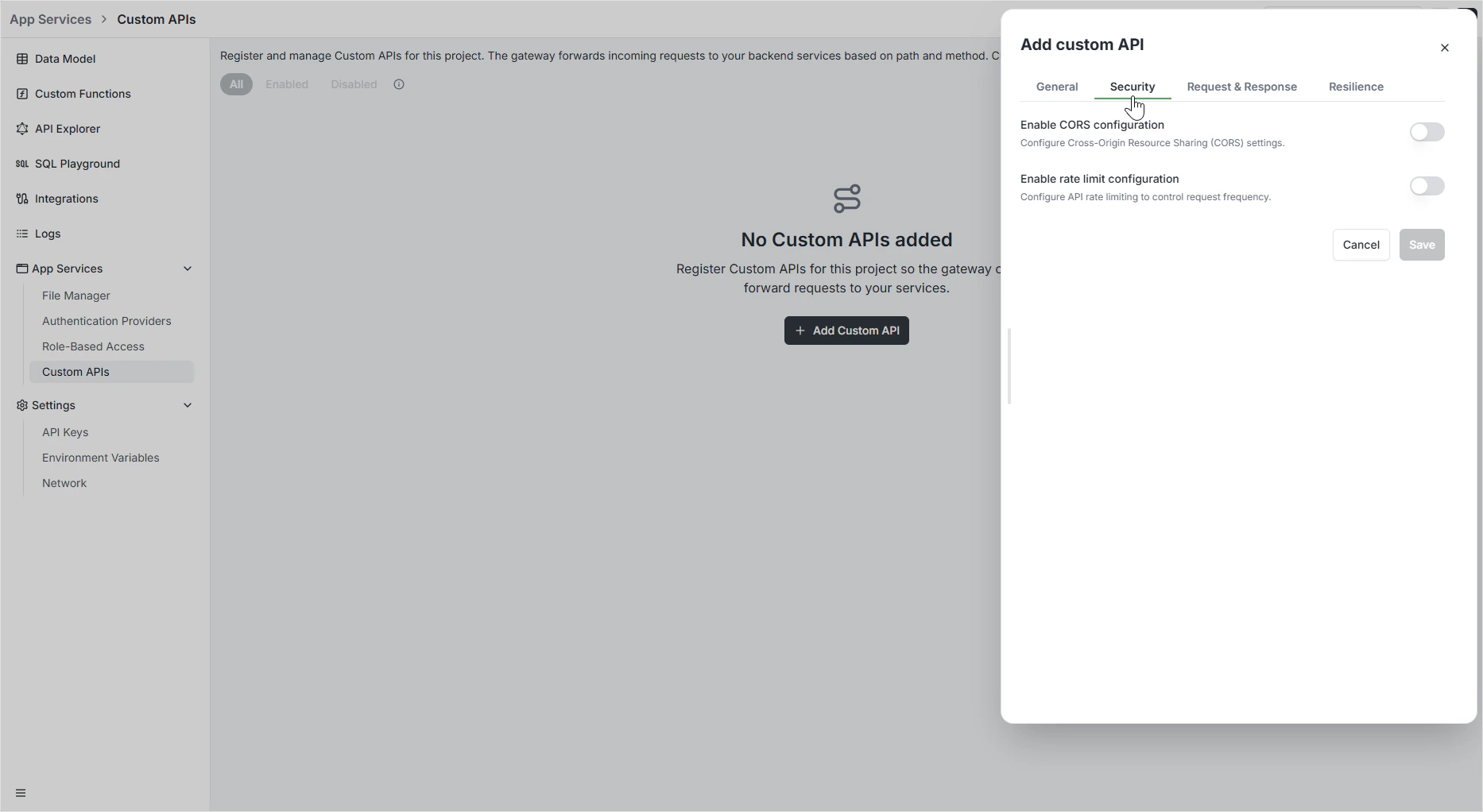
The **Security** tab controls cross-origin access and rate limits per route.
#### CORS
| Setting | What it does |
| ----------------------------- | -------------------------------------------------------------- |
| **Allow All Origins** | Accept requests from any domain. Disable to use the allowlist. |
| **Allowed Origins** | Whitelist of specific domains permitted to call the route. |
| **Allowed Methods & Headers** | HTTP verbs and custom headers the gateway will accept. |
| **Allow Credentials** | Whether browsers should include cookies or auth headers. |
| **Preflight Cache Duration** | How long browsers cache the CORS preflight response. |
| **Expose Headers** | Response headers safe to expose to the client. |
#### Rate limiting
| Setting | What it does |
| ------------------- | --------------------------------------------------------- |
| **Average** | Baseline requests allowed per time unit. |
| **Burst Allowance** | Extra requests allowed in short spikes above the average. |
| **Time Window** | Counting period — typically per second or per minute. |
| **Rate Limit by** | How to identify unique callers — typically by IP address. |
When the limit is exceeded, the gateway returns `429 Too Many Requests` with a `Retry-After` header.
### Security — CORS and rate limiting
The **Security** tab controls cross-origin access and rate limits per route.
#### CORS
| Setting | What it does |
| ----------------------------- | -------------------------------------------------------------- |
| **Allow All Origins** | Accept requests from any domain. Disable to use the allowlist. |
| **Allowed Origins** | Whitelist of specific domains permitted to call the route. |
| **Allowed Methods & Headers** | HTTP verbs and custom headers the gateway will accept. |
| **Allow Credentials** | Whether browsers should include cookies or auth headers. |
| **Preflight Cache Duration** | How long browsers cache the CORS preflight response. |
| **Expose Headers** | Response headers safe to expose to the client. |
#### Rate limiting
| Setting | What it does |
| ------------------- | --------------------------------------------------------- |
| **Average** | Baseline requests allowed per time unit. |
| **Burst Allowance** | Extra requests allowed in short spikes above the average. |
| **Time Window** | Counting period — typically per second or per minute. |
| **Rate Limit by** | How to identify unique callers — typically by IP address. |
When the limit is exceeded, the gateway returns `429 Too Many Requests` with a `Retry-After` header.
 For project-wide CORS and rate-limit defaults, see [Backend → Settings → Network](/features/backend/settings/network).
### Request & Response — transformations
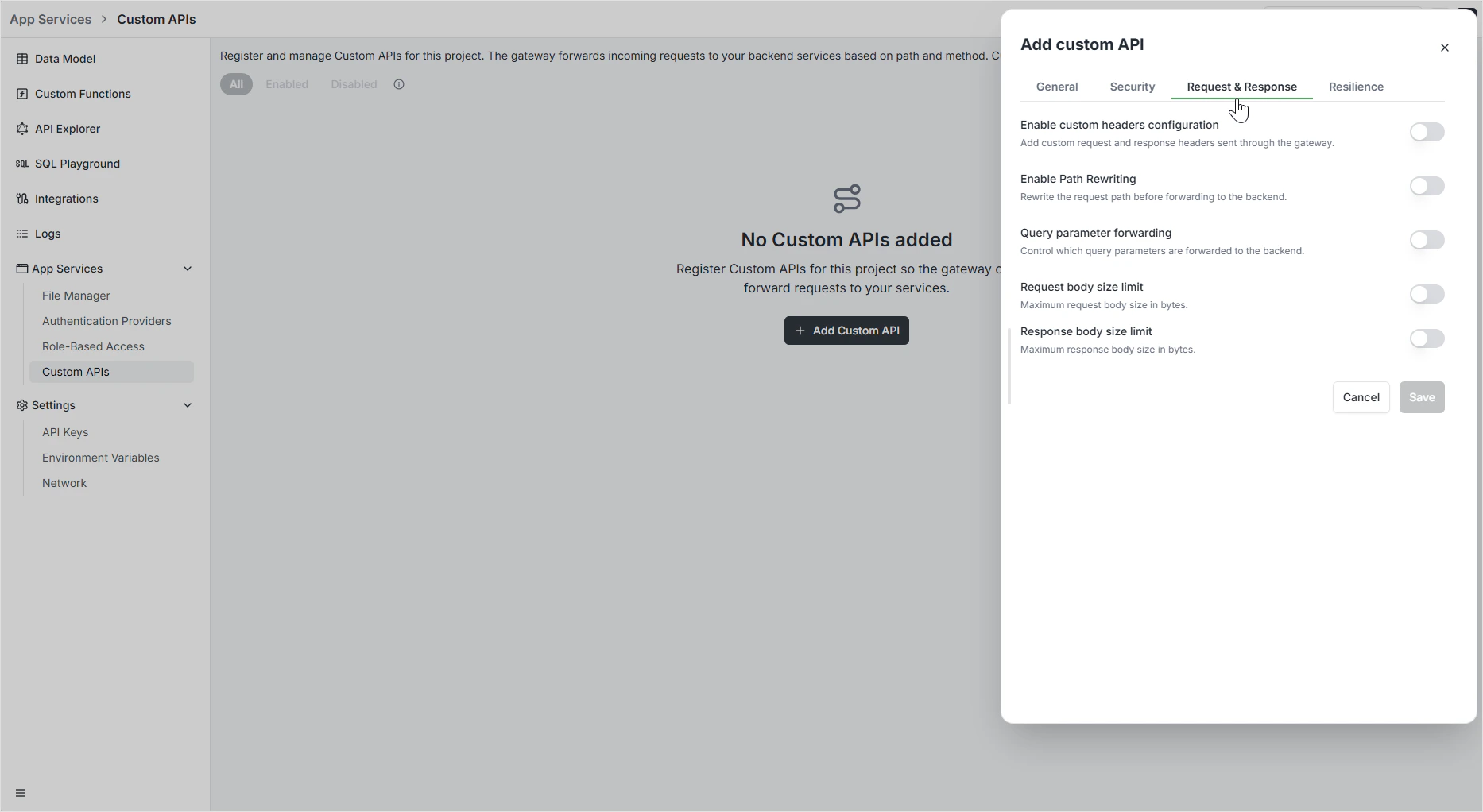
The **Request & Response** tab controls how data is shaped on the way through the gateway.
#### Custom headers
Add or override headers per route:
* **Custom request headers** — sent to your backend on top of what the client sent.
* **Custom response headers** — added to the response on the way back.
Each header is a name and a value. Useful for injecting service-to-service auth tokens or stamping responses with a `Cache-Control` policy.
#### Path rewriting
Modify the request path before it reaches your backend:
| Operation | Example |
| ------------------------------- | ------------------------------------------------- |
| **Strip prefix** | `/v1/users/123` → `/users/123` (strip `/v1`). |
| **Add prefix** | `/users/123` → `/api/users/123` (add `/api`). |
| **Regex pattern & replacement** | `^/old/(.*)` → `/new/$1` for arbitrary remapping. |
#### Query parameter forwarding
Choose which query string parameters reach the backend:
| Mode | Behavior |
| --------------- | ------------------------------------------------------- |
| **Forward all** | Pass the entire query string unchanged. |
| **Allow list** | Forward only the named parameters. |
| **Deny list** | Forward all parameters except those explicitly blocked. |
#### Body size limits
| Setting | Purpose |
| ---------------------------- | ----------------------------------------- |
| **Request body size limit** | Maximum size of incoming request bodies. |
| **Response body size limit** | Maximum size of outgoing response bodies. |
Exceeding either limit returns `413 Payload Too Large`.
For project-wide CORS and rate-limit defaults, see [Backend → Settings → Network](/features/backend/settings/network).
### Request & Response — transformations
The **Request & Response** tab controls how data is shaped on the way through the gateway.
#### Custom headers
Add or override headers per route:
* **Custom request headers** — sent to your backend on top of what the client sent.
* **Custom response headers** — added to the response on the way back.
Each header is a name and a value. Useful for injecting service-to-service auth tokens or stamping responses with a `Cache-Control` policy.
#### Path rewriting
Modify the request path before it reaches your backend:
| Operation | Example |
| ------------------------------- | ------------------------------------------------- |
| **Strip prefix** | `/v1/users/123` → `/users/123` (strip `/v1`). |
| **Add prefix** | `/users/123` → `/api/users/123` (add `/api`). |
| **Regex pattern & replacement** | `^/old/(.*)` → `/new/$1` for arbitrary remapping. |
#### Query parameter forwarding
Choose which query string parameters reach the backend:
| Mode | Behavior |
| --------------- | ------------------------------------------------------- |
| **Forward all** | Pass the entire query string unchanged. |
| **Allow list** | Forward only the named parameters. |
| **Deny list** | Forward all parameters except those explicitly blocked. |
#### Body size limits
| Setting | Purpose |
| ---------------------------- | ----------------------------------------- |
| **Request body size limit** | Maximum size of incoming request bodies. |
| **Response body size limit** | Maximum size of outgoing response bodies. |
Exceeding either limit returns `413 Payload Too Large`.
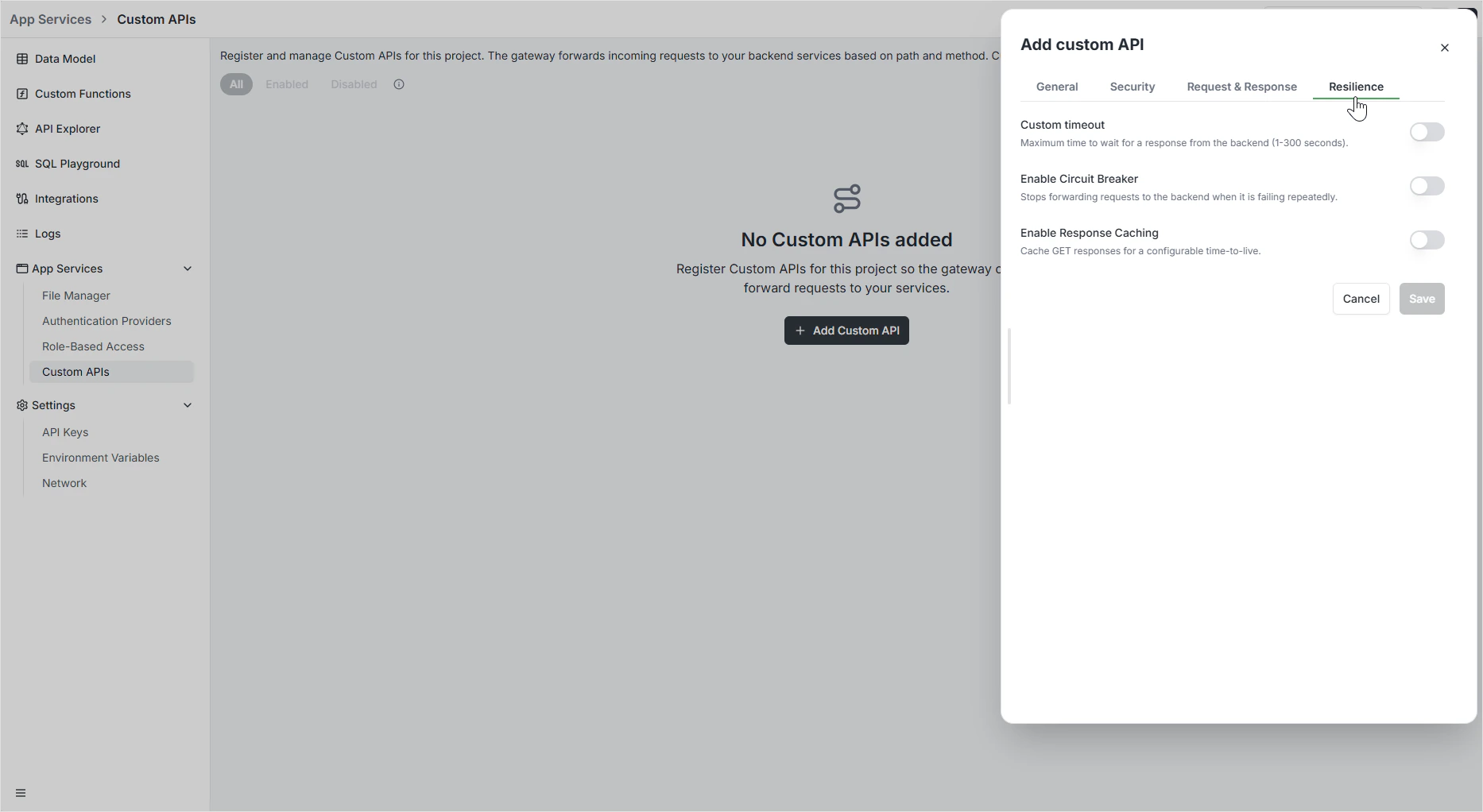
 ### Resilience — timeouts, circuit breakers, caching
The **Resilience** tab keeps your route healthy when the backend doesn't cooperate.
#### Custom timeout
How long the gateway waits for a response before giving up. Set between 1 and 300 seconds. Without a timeout, a slow backend can pin gateway capacity indefinitely.
#### Circuit breaker
Automatically stop forwarding requests to a failing backend so failures don't cascade. Apply a preset or write a custom expression:
| Preset | Trips when |
| ---------------- | ---------------------------------------------- |
| **50% errors** | Error ratio crosses 0.5 over the check window. |
| **30% errors** | Error ratio crosses 0.3. |
| **High latency** | p99 response time crosses the threshold. |
| **500+ errors** | Sustained 5xx responses. |
| Setting | Purpose |
| ---------------- | ---------------------------------------------------------- |
| **Expression** | Custom trip condition (e.g., `NetworkErrorRatio() > 0.5`). |
| **Check (s)** | How often the breaker checks while open. |
| **Fallback (s)** | Wait before attempting a partial close. |
| **Recovery (s)** | Recovery phase duration before fully closing. |
#### Response caching
| Setting | Purpose |
| ----------------------- | ------------------------------------------------------------------------------------------------------------- |
| **Cache TTL (seconds)** | Time-to-live for `GET` responses. Subsequent identical requests within the TTL are served from gateway cache. |
Caching applies only to safe (`GET`) requests. Mutations are never cached.
### Resilience — timeouts, circuit breakers, caching
The **Resilience** tab keeps your route healthy when the backend doesn't cooperate.
#### Custom timeout
How long the gateway waits for a response before giving up. Set between 1 and 300 seconds. Without a timeout, a slow backend can pin gateway capacity indefinitely.
#### Circuit breaker
Automatically stop forwarding requests to a failing backend so failures don't cascade. Apply a preset or write a custom expression:
| Preset | Trips when |
| ---------------- | ---------------------------------------------- |
| **50% errors** | Error ratio crosses 0.5 over the check window. |
| **30% errors** | Error ratio crosses 0.3. |
| **High latency** | p99 response time crosses the threshold. |
| **500+ errors** | Sustained 5xx responses. |
| Setting | Purpose |
| ---------------- | ---------------------------------------------------------- |
| **Expression** | Custom trip condition (e.g., `NetworkErrorRatio() > 0.5`). |
| **Check (s)** | How often the breaker checks while open. |
| **Fallback (s)** | Wait before attempting a partial close. |
| **Recovery (s)** | Recovery phase duration before fully closing. |
#### Response caching
| Setting | Purpose |
| ----------------------- | ------------------------------------------------------------------------------------------------------------- |
| **Cache TTL (seconds)** | Time-to-live for `GET` responses. Subsequent identical requests within the TTL are served from gateway cache. |
Caching applies only to safe (`GET`) requests. Mutations are never cached.
 ## Programmatic management
Routes can also be created via GraphQL — useful for codifying gateway configuration alongside your data model.
```graphql theme={null}
mutation RegisterRoute($input: RegisterRouteInput!) {
registerRoute(input: $input) {
id
path
targetUrl
methods
enabled
environment
}
}
```
When you delete an environment, all routes attached to it are cleaned up automatically. To delete environment routes manually:
```graphql theme={null}
mutation DeleteRoutesByEnvironment($input: DeleteRoutesByEnvironmentInput!) {
deleteRoutesByEnvironment(input: $input) {
deletedCount
}
}
```
## Permissions
Custom API routes inherit the same auth and authorization model as the rest of your backend. Authenticated requests carry their roles to the route, where you can apply per-route policy. For full coverage, see [Role-Based Access](/features/backend/app-services/role-based-access).
## FAQ
Use a Custom API when you have an existing service to expose — the gateway adds CORS, rate limiting, and resilience without code. Use a custom function when the logic itself runs inside Archie. The two compose: a Custom API can route to a custom function the same way it routes to any backend.
Optionally — tick **Gateway routes** in the branching modal. Each copy gets a new ID. After branching, edits in either environment are independent.
[Settings → Network](/features/backend/settings/network) sets the default CORS for the auto-generated GraphQL and REST APIs. Per-route CORS overrides that for a specific Custom API path.
No — caching only applies to `GET`. Caching mutations would silently return stale state to clients that expected fresh writes.
The gateway short-circuits incoming requests with a `503 Service Unavailable` response without forwarding to the backend. After the recovery period, it lets a small number of probe requests through to test whether the backend has recovered before fully closing the circuit.
## Programmatic management
Routes can also be created via GraphQL — useful for codifying gateway configuration alongside your data model.
```graphql theme={null}
mutation RegisterRoute($input: RegisterRouteInput!) {
registerRoute(input: $input) {
id
path
targetUrl
methods
enabled
environment
}
}
```
When you delete an environment, all routes attached to it are cleaned up automatically. To delete environment routes manually:
```graphql theme={null}
mutation DeleteRoutesByEnvironment($input: DeleteRoutesByEnvironmentInput!) {
deleteRoutesByEnvironment(input: $input) {
deletedCount
}
}
```
## Permissions
Custom API routes inherit the same auth and authorization model as the rest of your backend. Authenticated requests carry their roles to the route, where you can apply per-route policy. For full coverage, see [Role-Based Access](/features/backend/app-services/role-based-access).
## FAQ
Use a Custom API when you have an existing service to expose — the gateway adds CORS, rate limiting, and resilience without code. Use a custom function when the logic itself runs inside Archie. The two compose: a Custom API can route to a custom function the same way it routes to any backend.
Optionally — tick **Gateway routes** in the branching modal. Each copy gets a new ID. After branching, edits in either environment are independent.
[Settings → Network](/features/backend/settings/network) sets the default CORS for the auto-generated GraphQL and REST APIs. Per-route CORS overrides that for a specific Custom API path.
No — caching only applies to `GET`. Caching mutations would silently return stale state to clients that expected fresh writes.
The gateway short-circuits incoming requests with a `503 Service Unavailable` response without forwarding to the backend. After the recovery period, it lets a small number of probe requests through to test whether the backend has recovered before fully closing the circuit.