> ## Documentation Index
> Fetch the complete documentation index at: https://archie.com/docs/llms.txt
> Use this file to discover all available pages before exploring further.
# Overview
> Build production-ready applications with Archie's blueprint-first flow, integrated backend, visual editing, and full-stack code generation.
Build production-ready applications by going from idea to blueprint to deployed code. Define what to build, generate it, customize it, and ship it — all in one place.
## Start building with Archie
Define what you're building before you build it. Personas, features, architecture, and tech stack — all generated from your idea.
Detailed specifications generated from your blueprint. Coming soon.
Customize the generated UI with the visual editor, the chat, or by editing code directly.
Archie Core — your managed backend with database, APIs, authentication, and integrations built in.
## How Archie works
Archie generates a structured plan before any code is written. You describe what you want to build in plain language. Archie produces a blueprint covering modules, user types, system services, integrations, and tech stack. You edit the blueprint until it matches your intent — that is where your time goes.
When the blueprint is ready, Archie runs the build. The output is a real full-stack application: a frontend hosted on a global CDN, a backend running on Archie Core (PostgreSQL or MySQL with auto-generated GraphQL and REST APIs, authentication, file storage, RBAC), and the wiring between them.
After the build, you keep iterating. Talk to Archie to apply changes. Use the visual editor for layout and copy. Push to GitHub and edit code locally. The blueprint is your control surface for structural changes; the running app is where everything else happens.
## Assets
Every project has an Assets surface for images, videos, documents, and other files that your app uses or displays. Upload from the project, browse with search and filters, and reference assets from the visual editor, frontend code, or custom backend functions. Files are served from the storage provider configured in your blueprint. See [Assets](/features/assets/overview).
## Develop and debug your app
The chat is the primary modality for editing the running app. Describe a change in plain language ("add a search field to the orders page", "make the dashboard sidebar collapsible") and Archie applies it across the relevant files. The chat understands the project's structure and generates code that matches the existing patterns.
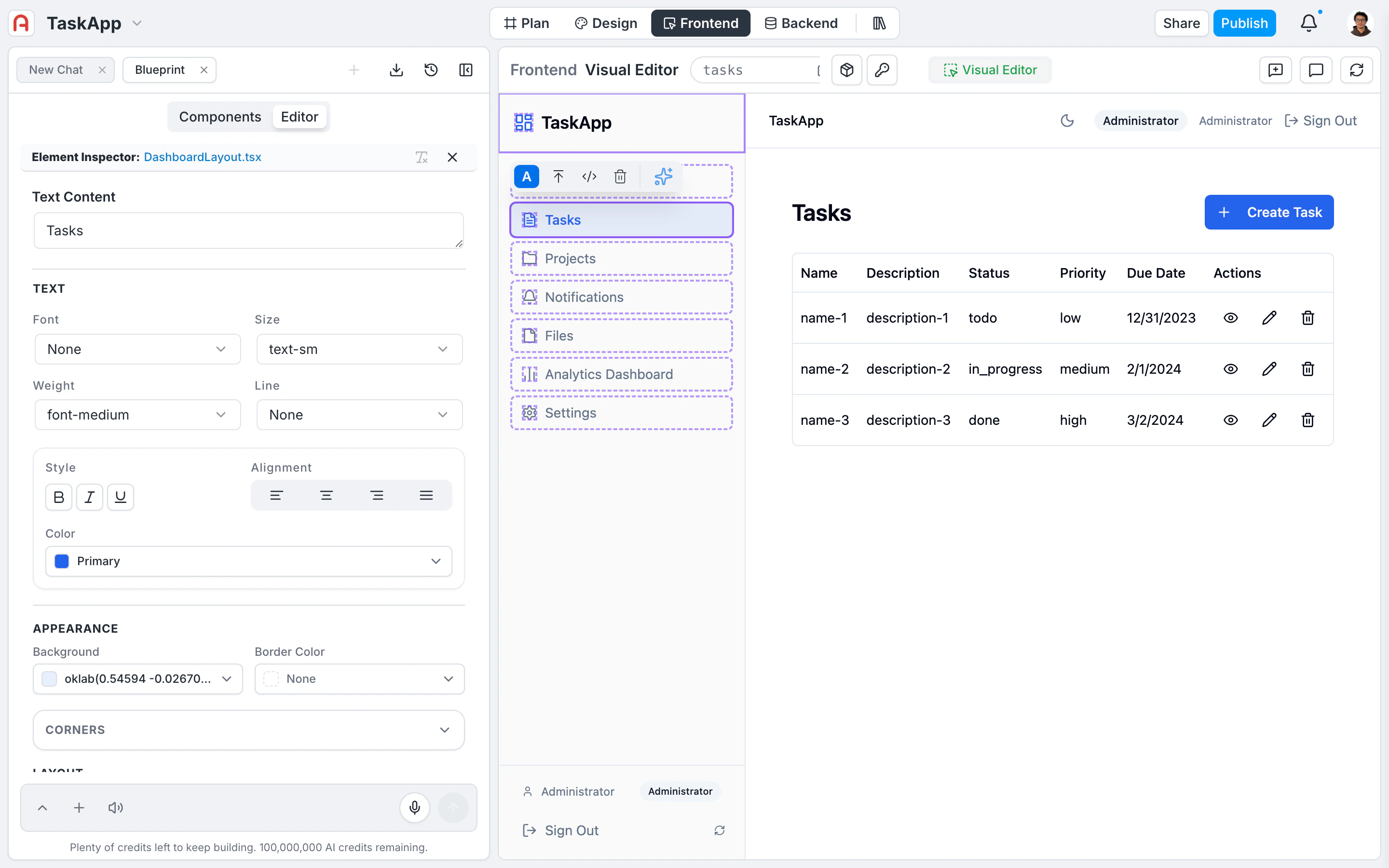
The visual editor is point-and-click. Click an element in the live preview, the inspector panel surfaces its properties — text, color, padding, position — and changes apply live. Useful for layout tweaks, copy edits, image swaps, and component-level styling. See [Visual editor](/features/frontend/visual-editor).
 GitHub integration provides two-way sync. Archie pushes generated code to a repository you choose, and pulls back any commits made outside Archie. Branch-based deployments, pull request reviews, and standard Git workflows all work. See [Connecting GitHub](/features/github/connecting).
The activity feed shows every action across your project — builds, deployments, blueprint edits, comments. Logs from the backend stream live across services and environments. Filter by environment, service, or severity. See [Logs](/features/backend/logs).
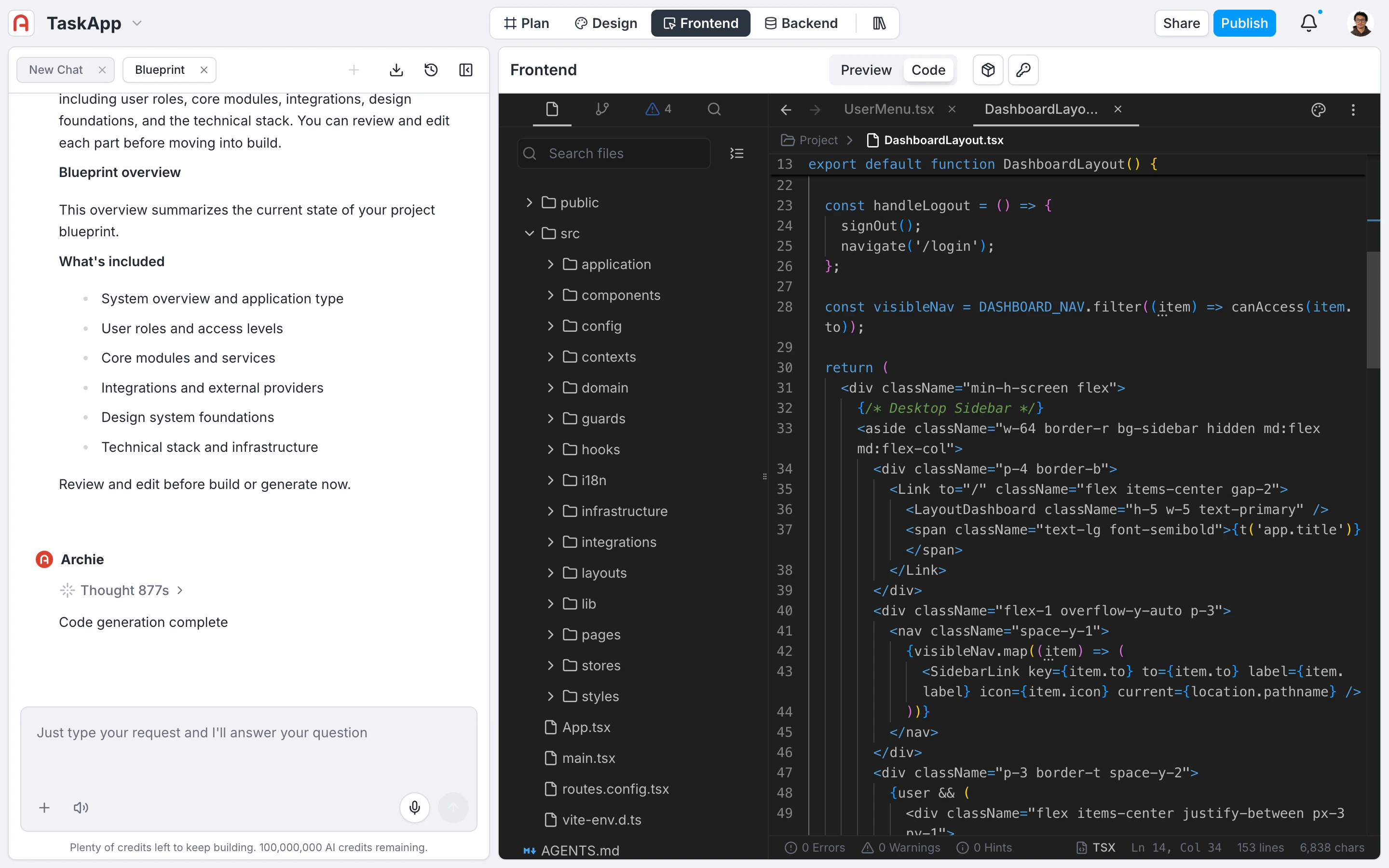
Generated apps follow a predictable structure: `app/` for routes (Next.js or your stack's equivalent), `components/` for reusable UI, `lib/` for utilities, `schema/` for the data model. The backend exposes the same model through GraphQL and REST automatically. See the [Backend overview](/features/backend/overview) for the full layout.
GitHub integration provides two-way sync. Archie pushes generated code to a repository you choose, and pulls back any commits made outside Archie. Branch-based deployments, pull request reviews, and standard Git workflows all work. See [Connecting GitHub](/features/github/connecting).
The activity feed shows every action across your project — builds, deployments, blueprint edits, comments. Logs from the backend stream live across services and environments. Filter by environment, service, or severity. See [Logs](/features/backend/logs).
Generated apps follow a predictable structure: `app/` for routes (Next.js or your stack's equivalent), `components/` for reusable UI, `lib/` for utilities, `schema/` for the data model. The backend exposes the same model through GraphQL and REST automatically. See the [Backend overview](/features/backend/overview) for the full layout.
 ## Explore
Add tables, fields, and relationships. APIs regenerate automatically.
Visual editor for layout and copy, IDE for code, chat for everything in between.
Stripe, SendGrid, Twilio, Slack, Shopify, or build your own.
Development, staging, production, and beyond — with CI/CD between them.
Authenticate external clients with scoped, per-environment API keys.
Two-way code sync, pull requests, and branch-based deployments.
## Explore
Add tables, fields, and relationships. APIs regenerate automatically.
Visual editor for layout and copy, IDE for code, chat for everything in between.
Stripe, SendGrid, Twilio, Slack, Shopify, or build your own.
Development, staging, production, and beyond — with CI/CD between them.
Authenticate external clients with scoped, per-environment API keys.
Two-way code sync, pull requests, and branch-based deployments.