

What is in a plan
A plan has five sections. Each is independently editable:- Overview — a high-level summary of the app’s purpose
- Modules — the features and capabilities your app offers
- User types — the people who use the app and what each can do
- System services — built-in services like authentication, file storage, and roles
- Integrations — third-party services your app talks to (Stripe, SendGrid, and so on)
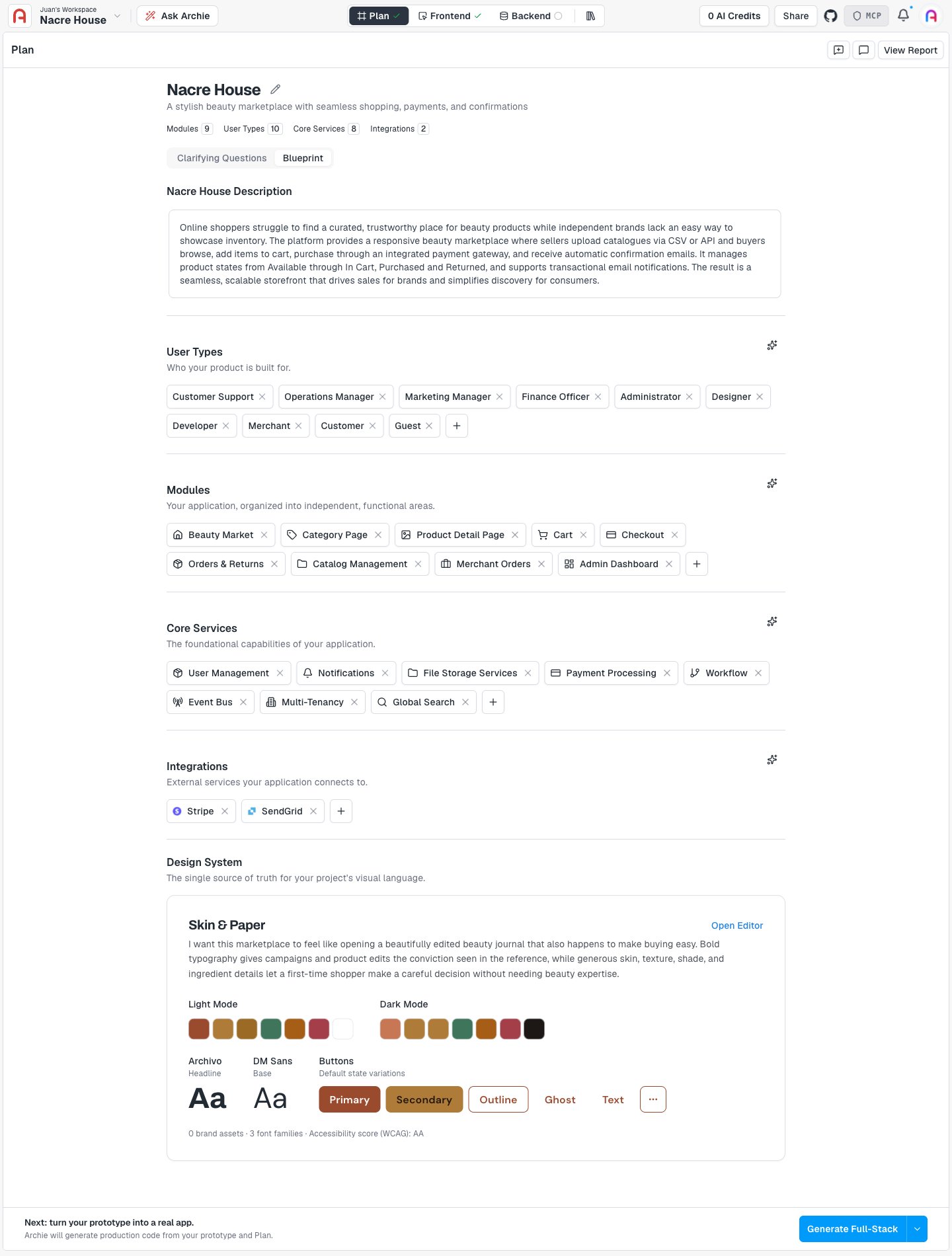
The tech stack (frameworks, runtime, database) is chosen and managed by Archie automatically. It is not shown or editable in the plan — the plan stays agnostic to the underlying stack.
How the plan relates to the rest of Archie
The plan is the high-level description of your app. The specifications hold finer-grained detail (system requirements, visual design principles, technical decisions). When you run the build, Archie reads the plan and the specifications together. After the build, the visual editor and frontend surfaces let you make small, direct changes. For larger changes, come back to the plan and rebuild.What you will do here
- Generate a plan from an idea, answering Archie’s clarifying questions along the way
- Review your generated plan
- Edit each section: modules, user types, services, integrations
- Iterate using the plan chat
- Decide when to run the build
FAQ
Can I edit the plan after the build?
Can I edit the plan after the build?
Yes. Edit and run again. The next build will incorporate your changes.
Can I have more than one plan per project?
Can I have more than one plan per project?
No. Each project has one plan. To explore alternatives, create a new project.
What if I do not need a section?
What if I do not need a section?
Leave it minimal. For example, an internal tool may not need integrations. Archie will not force features into your build.